


All You Need to Know About Mosquitoes in South Dakota
Mosquitoes play a role in our ecosystems, but some species can transmit diseases like West Nile Virus (WNV). South Dakota consistently reports some of the highest WNV activity in the country, making mosquito awareness and prevention crucial for community safety. This page offers a comprehensive overview of mosquito biology, habitats, life cycle, and the species most commonly found in South Dakota.
On this Page:
Mosquito Life Cycle | Mosquito Habitats | Prevention Tips | Repellent Information | Common Mosquitoes in SD | FAQs
West Nile Virus & Mosquito Activity Season in South Dakota
Mosquito activity in South Dakota usually begins in May and peaks from July through September when temperatures are warm, and mosquito populations are highest. West Nile Virus activity generally increases in mid-to-late summer, with most human cases reported between August and September.
Mosquito Life Cycle
Mosquitoes need standing water to lay eggs and complete their life cycle.
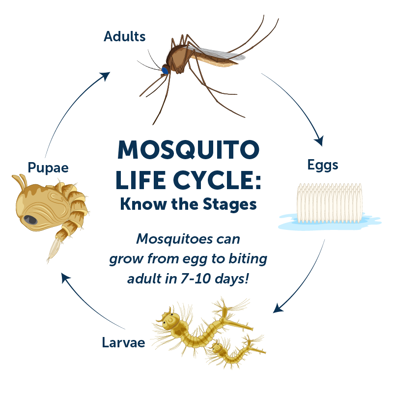
Four Stages
- Egg – laid on water surfaces or in areas that flood.
Female mosquitoes lay eggs on the surface of fresh or stagnant water. Most eggs hatch within 48 hours. - Larva – aquatic “wigglers” that feed on organic material.
Larvae live in the water. They develop into Pupae in as few as 5 days. - Pupa – transitional floating stage.
Pupae live in water. They develop into adult, flying mosquitoes in 2-3 days. - Adult – emerges from the pupa, crawls up out of the water to fly away; females seek blood meals.
Time Frame
Under the right conditions, mosquitoes can develop from egg to adult in as little as 7 to 10 days.
Common Mosquito Habitats in South Dakota
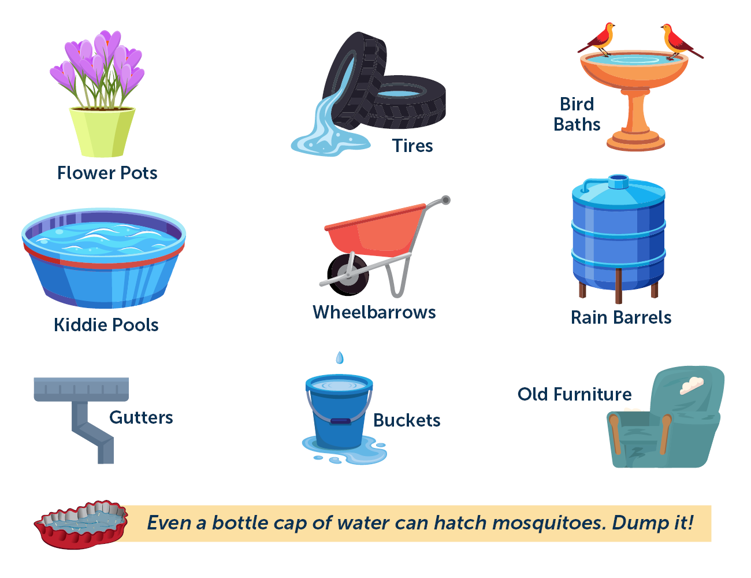
Different mosquito species breed in different environments, including:
- Stagnant water (ditches, ponds, cattail marshes)
- Temporary pools, including water pools as small as livestock hoof prints
- Backyard containers (buckets, tires, gutters, birdbaths)
- Irrigated fields
- Floodwater areas (especially as seen across East River counties)
- Tree holes and natural depressions
- Stormwater basins & retention ponds
- Urban environments with man-made water sources
Mosquito Prevention Infographic
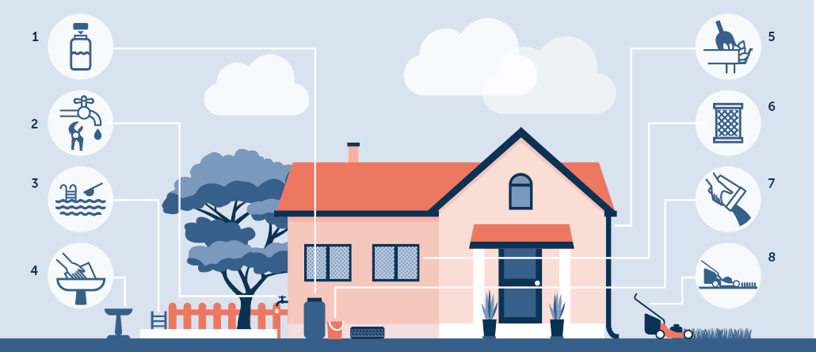
How to Reduce Mosquito Breeding Around Your Home
- Seal all water deposits
- Fix leaky faucets
- Protect and clean pools and ponds
- Clean bird baths once a week
- Clean rain gutters
- Install screens on windows and doors
- Drain standing water in buckets, tires, and flower pots
- Keep grass short
Mosquito Prevention in the Yard Infographic
Protect Yourself From Mosquito Bites
- Use EPA-registered repellents (DEET, picaridin, IR3535, oil of lemon eucalyptus)
- Wear long sleeves and pants when possible
- Avoid peak biting times (dusk to dawn)
- Use fans when sitting outdoors
- Treat clothing with permethrin (not for skin)
- Ensure window/door screens are intact
Culex tarsalis:
The Irrigation Mosquito and Primary West Nile Virus Vector
This is the primary mosquito responsible for spreading West Nile virus in South Dakota.
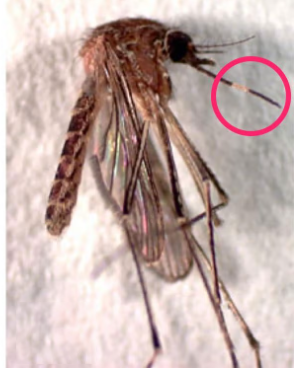
Identification:
- Medium-sized, brown body
- Distinctive white band on proboscis (“tarsal band”)
- White markings on legs
Habitat:
- Rural and semi-rural areas
- Lays eggs in most types of ground water, such as irrigation and road ditches, hoof prints, and temporary pools
- Prefers warm water sources rich in organic material that fill regularly. Larvae are less commonly found in artificial containers, stagnant ponds, or cattail marshes
Behavior:
- Most active from dusk to dawn, particularly later at night (10 PM to 2 AM).
- Females prefer to feed on birds, but also bite people and other mammals. This feeding behavior helps spread West Nile virus from birds to humans.
- Egg-laying occurs several days after feeding. After obtaining a blood meal, females rest for a few days before searching for standing water to lay eggs; eggs are laid on the water surface. Most stay close to where they hatch but can travel up to 2 miles. Wind can carry them even farther.
- Resting behavior: When not active, Culex mosquitoes rest in:
- Tall grass
- Shrubs
- Dense vegetation
- Cool, dark, and humid outdoor areas
Culex pipiens / Culex restuans:
Urban/Peri-Urban Mosquitoes
These mosquitoes can also spread West Nile virus and are common in towns and cities.
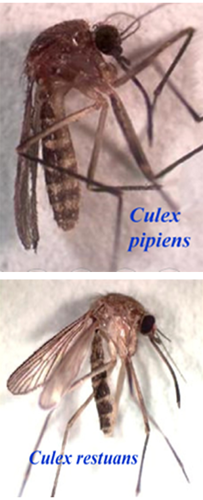
Identification:
- Small- to medium-sized
- Brown, without the white tarsal band seen in Culex tarsalis
Habitat:
- Storm drains
- Rain barrels
- Backyard containers
- Gutters & shaded standing water
Behavior:
- Active at night
- Cx. pipiens readily enter homes; Cx. restuans stays in the environment
- Both prefer birds as hosts, but Cx pipiens will also feed on mammals, including people (important in the WNV transmission cycle)
- Weak fliers (generally < 1 mile from breeding site)
- Overwinters in garages, sheds, and basements
- Eggs laid on water surface
Aedes vexans:
The Floodwater Mosquito
South Dakota’s most abundant nuisance biter.
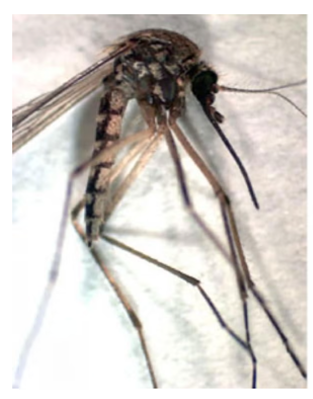
Identification:
- Black and white “striped” appearance on abdomen
- Smaller size
- Feisty, aggressive biter
Habitat:
- Flooded fields, roadside ditches
- Prairie potholes
- Temporary water after rains
Behavior:
- Painful, aggressive biters
- Bites during the day when disturbed, but mostly aggressive during dusk and early evening
- Rarely enter homes
- Prefer mammals (including humans)
- Strong fliers, often traveling several miles
- Most common nuisance mosquito in South Dakota, especially common in the eastern parts of the state
- Eggs laid at the edge of flood-prone ground depressions
Aedes dorsalis:
The Saltmarsh/Floodwater Mosquito
An aggressive biter that can cause large mosquito populations after flooding events.
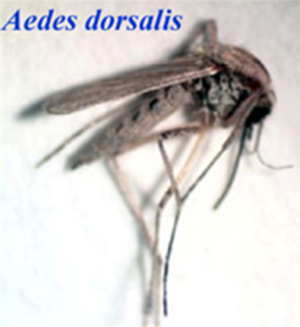
Identification:
- Pale band on legs
- Light brown to tan body
- Quick, darting flight
Habitat:
- Semi-alkaline or brackish water
- Prairie potholes
- Wetlands that flood intermittently
Behavior:
- Most active during the day
- Capable of long-distance flight
- Population often spikes after summer storms and flooding
Common Questions About Mosquitoes
What mosquito spreads West Nile virus in South Dakota?
The primary mosquito that spreads West Nile virus in South Dakota is Culex tarsalis.
When are mosquitoes most active in South Dakota?
Mosquito activity typically begins in May and peaks from July through September.
How can I reduce mosquitoes around my home?
Remove standing water, clean gutters and bird baths, maintain pools, and keep screens in good condition.
What insect repellent works best against mosquitoes?
EPA-registered repellents containing DEET, picaridin, IR3535, or oil of lemon eucalyptus are effective.
Resources:
- Centers for Disease Control and Prevention (CDC).
- Mosquito Life Cycle. https://www.cdc.gov/mosquitoes/about/index.html
- West Nile Virus Ecology and Transmission. https://www.cdc.gov/west-nile-virus/
- Using EPA-Registered Repellents.https://www.epa.gov/insect-repellents/what-insect-repellent
- Environmental Protection Agency (EPA).
- Find the Right Insect Repellent. https://www.epa.gov/insect-repellents
- American Mosquito Control Association (AMCA).
- Mosquito Biology and Ecology. https://www.mosquito.org/mosquito-biology/
- South Dakota Department of Health (SD DOH).
- West Nile Virus Surveillance & Epidemiology. https://doh.sd.gov/topics/diseases/infectious-diseases/vector-borne-diseases/mosquito-borne-diseases/west-nile-virus/
- South Dakota State University Extension.
- Mosquitoes & Vector Control Resources. https://extension.sdstate.edu
- University of California, Davis – Mosquito Identification Resources.
- Culex, Aedes, and Anopheles species descriptions.
https://vectorbio.ucdavis.edu
- Culex, Aedes, and Anopheles species descriptions.
- USDA / Agricultural Research Service.
- Mosquito Behavior & Ecology Fact Sheets. https://www.ars.usda.gov
- World Health Organization (WHO).
- Vector Surveillance & Control. https://www.who.int/health-topics/vector-borne-diseases