


Community Designation Application - Link to form
- Automated External Defibrillator (AED): Machine designed to diagnose and treat life-threatening heart rhythms during sudden cardiac arrest.
- Cardiac Emergency Response Plan (CERP): CERP prepares your team to recognize an emergency, activate a coordinated response, start CPR, and use an AED with confidence—so your organization is ready to act when every second counts.
- Cardiopulmonary resuscitation (CPR): An emergency life-saving procedure performed when a person's heart stops beating or they stop breathing normally.
- Emergency Medical Services (EMS): Coordinated, 24/7 healthcare and public safety system that provides urgent pre-hospital clinical care, stabilization, and transport for people experiencing sudden illness or injury.
- National Emergency AED + Resource (NEAR) Registry (formerly PulsePoint): A free, centralized database administered by the PulsePoint Foundation that tracks life-saving emergency equipment.
- RapidSOS: An intelligent safety platform that securely connects real-time data from smartphones, wearable devices, connected vehicles, and IoT sensors directly to 911 dispatch centers and first responders.
- Sudden cardiac arrest (SCA): A life-threatening medical emergency where the heart abruptly stops beating and blood flow to the brain and vital organs ceases.
- Test run:
- Contact your local 911 dispatcher. Use the local 911 dispatcher contact and coverage map to identify the appropriate contact.
- Request a test. Explain that your community has mapped its AEDs and would like to test whether locations appear correctly in RapidSOS.
- Schedule and conduct testing. Coordinate a date, time, and location with the local 911 dispatcher. Have a volunteer visit several AED locations while dispatch confirms they are visible in RapidSOS.
The Cardiac Ready Communities (CRC) Program, established in 2019, focuses on educating, equipping, and empowering local community members to be better prepared and more confident in helping a patient experiencing a cardiac event before the ambulance arrives. The CRC Program runs through a partnership of the SD Department of Health (SD DOH), South Dakota Foundation for Medical Care (SDFMC), and the South Dakota Cardiovascular Collaborative (SDCC). The CRC Program focuses on advancing wellness for all, optimizing health through chronic disease prevention, improving response to acute cardiovascular incidents, and supporting disease management. The CRC Program promotes the American Heart Association (AHA) Chain of Survival as shown below, which can improve the chances of survival and recovery for victims of cardiac events.
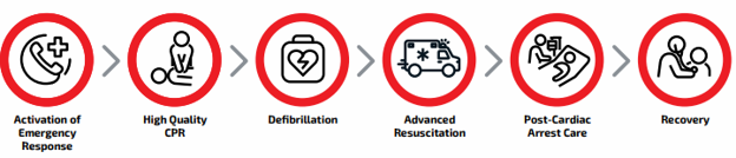
Please visit Cardiac Ready Communities | South Dakota Department of Health (sd.gov) for more information and to hear about other communities that have achieved this designation.
Becoming a CRC starts with identifying a local champion—someone willing to lead the effort, bring people together, and keep the work moving forward. This champion may be an EMS provider, healthcare worker, public health representative, city leader, school staff member, business owner, or an active community member who wants to make a difference.
Once a champion is identified, it is crucial to build a team of local voices who can help strengthen the community’s response to cardiac emergencies. This team may include EMS, fire and law enforcement, healthcare professionals, school representatives, city council members, local businesses, faith-based organizations, service clubs, athletic programs, senior centers, and residents who are committed to saving lives in their community.
The next step is to fill out the letter of intent. By completing this letter, you are notifying the South Dakota CRC Committee of your intent. You will have one (1) year from the date the letter of intent is submitted to complete the designation process.
As you begin implementation, this application will help your team work through five focus areas that improve readiness, response, and long-term heart health. These focus areas include increasing awareness of cardiac emergencies, expanding CPR and AED training, identifying and maintaining AEDs, strengthening emergency response partnerships, supporting community heart health and prevention, and creating a sustainability plan for continued success.
As communities complete the application, they should describe the people, resources, activities, and plans already in place, as well as the steps they are taking to improve. The strongest applications will show how local partners are working together and how the community plans to continue these efforts beyond the initial designation.
Upon CRC designation, communities can use their newly gained designation as an opportunity to celebrate. Street signs will be provided to the community to recognize its efforts.
Additionally, champions with CRC designation are encouraged to participate in SDCC, a voluntary group of SD medical and public health professionals working to improve the quality of life through the prevention and control of heart disease and stroke. We encourage you to participate in SDCC because you may be asked to share your experiences with others to promote cardiovascular health across South Dakota.
CRC designation is valid for three (3) years. During that time, communities will create a sustainability plan which includes building their team, strengthening partnerships, offering training, maintaining AED readiness, promoting heart health, and keeping cardiac emergency response a shared community priority. At the end of the three-year period, communities must renew their designation by submitting the CRC renewal application.
The following application is organized by focus areas to help communities identify current strengths, recognize opportunities for improvement, and document the steps they are taking to build a stronger cardiac response system. As you work through the application, the community should reference the Cardiac Ready Community blueprint to understand the designation process and required elements.
Please thoroughly review the application in its entirety. Our goal is to support every interested community in becoming Cardiac Ready. Please do not let questions, challenges, or barriers stop your momentum. This is a journey and a process. Reach out to our program lead Stephanie Hanson at stephanie.hanson@sdfmc.org for our solution-oriented technical assistance, and our team will support you.
#1: Bystander Response/CPR and AED Training
To provide awareness on SCA/heart attack/stroke and their warning signs, education on calling 911, information on heart health, and conduct approved CPR and AED training sessions within the community.
#2: Early Defibrillation/AED Identification
Recognizing the benefit of early defibrillation during an SCA and placing AEDs in public areas, in emergency response/first responder vehicles, and ensuring all AEDs are registered and in an Emergency Ready state (ready to use at time of need).
#3: Collaboration with Emergency Personnel
Strengthen collaboration among community leaders, 911 dispatch centers, emergency responders, and AED owners to ensure a coordinated and effective response to cardiac emergencies.
#4: Community Heart Health
Community Heart Health focuses on helping residents reduce their risk for heart disease and cardiac emergencies through local prevention efforts, screenings, healthy lifestyle activities, tobacco prevention, and policies that support access to AEDs in public spaces.
#5: Sustainability Plan
Sustainability ensures that Cardiac Ready Community efforts continue beyond the initial designation period. Communities need to develop a three-year sustainability plan that identifies goals and activities to maintain and strengthen cardiac readiness within the community.
General Resources
- American Heart Association
- American Red Cross
- Anyone Can Save a Life
- Be the Beat American Heart Association
- Cardiac Emergency Response Plan (CERP) Resources American Heart Association
- Citizen CPR Foundation
- Hands Only CPR American Heart Association
- Healthy SD
- Heart Rhythm Society
- NEAR Registry - Pulse Point Foundation
- Parent Heart Watch
- Sudden Cardiac Arrest Foundation
- Your On-site AED Program An Implementation Guide American Heart Association
AED Grants/Discount Opportunities
These organizations may be able to assist you with lower-cost AED purchases.
- AEDGrant Program
- Avera Heart Hospital, PAD Coordinator
- 605-977-7381
- Firehouse Subs Foundation Grant Program (priority given to First Responder agencies)
- GotAED Crowdfunding Site (priority given to Schools and Youth-serving facilities/organizations)
- Hopey’s Heart Foundation AED Grants
- Sanford Health, Manager of Sanford Center for Screening and The Sioux Falls Market Business Development and Strategy605-312-2186
- Sanford Health Community Impact
- Sioux Empire United Way (priority given to Nonprofits, Schools, Churches, and Government entities)
- Smart Heart Sports
- Sudden Cardiac Arrest Foundation (Additional Funding Sources for Schools)
AED Vendors*
These organizations sell AEDs.
*South Dakota Department of Health does not promote any AED vendors.
© 2026 South Dakota Department of Health. South Dakota Cardiac Ready Community. All Rights Reserved.
This checklist is for communities to use as you prepare the documents for your CRC application. Feel free to print and use as you see fit.
☐ Focus Area 1: Bystander Response/CPR and AED Training
☐ 1a. CPR/AED training events are required based on community population size. Provide the date, type of training/event, and number of participants for each event. Sign-in sheets may be provided as supporting documentation.
☐ 1b. Communities need to communicate with local middle and high schools to support compliance with state statutes requiring hands-only CPR training. Provide documentation demonstrating communication with local middle and high schools.
☐ 1c. Communities need to initiate and develop a CERP. Provide a copy of the CERP or documentation of its development in the first year of your sustainability plan.
☐ 1d. Once a CERP is developed, hold one training event each year. Provide the date and number of participants for each event. Sign-in sheets may be provided as supporting documentation.
☐ Focus Area 2: Early Defibrillation/AED Identification
☐ 2a. Public-access AEDs are required based on community population size. Provide a list of AED locations and the total number of AEDs in the community. Provide documentation that all public-access AEDs are registered in the NEAR Registry.
☐ 2b. Communities need to develop and disseminate a city/area map with all public-access AEDs identified including a link to the NEAR Registry app to promote awareness to the public. Provide a copy of the public access map and documentation of its dissemination, such as posters around the community or social media posts. A link to the NEAR Registry app should be included on the map.
☐ 2c. Communities need to maintain an AED maintenance log. Provide documentation of the AED maintenance log and/or the template of the log that will be used for each AED, or written confirmation that an external partner is managing it.
☐ Focus Area 3: Collaboration with Emergency Personnel
☐ 3a. Communities should collaborate with their local 911 dispatch center to review public access AED locations and verify that AEDs are registered in the NEAR AED Registry and available within their RapidSOS system. Communities should share the AED map with the local 911 dispatch center. Provide name and contact information of the local 911 dispatch representative engaged in the review process. Provide written confirmation that the local 911 dispatch center has received the AED map.
☐ 3b. Communities should complete a test run with their local 911 dispatch center to confirm AED location information is accurately displayed and accessible within emergency dispatch and response systems. Provide written confirmation that a test run was completed with the local 911 dispatch center.
☐ 3c. Communities need to connect with local law enforcement, EMS, and fire departments to determine whether their vehicles are equipped with AEDs and work to ensure all emergency vehicles are equipped with AEDs. Provide a list of total number of law enforcement, EMS, and fire department vehicles used within the community and the number of these vehicles equipped with AEDs. If all emergency vehicles are not equipped with AEDs, provide next steps in the first year of your sustainability plan.
☐ Focus Area 4: Community Heart Health
☐ 4a. Provide activities that increase physical activity and healthy eating in the community. Include all information on the implemented activity. This should include date, location, flyers, and pictures.
☐ 4b. Provide blood pressure and/or vascular screenings in the community. Provide detailed information about blood pressure and/or vascular screenings offered. This should include date, location, number of screenings completed, flyers, and pictures.
☐ 4c. Provide activities that decrease tobacco use and exposure in the community. Provide a list of planned or implemented activities.
☐ Focus Area 5: Sustainability Plan
☐ 5a. Develop a three-year Sustainability Plan that identifies 3–5 goals or activities for each of the four Cardiac Ready Community focus areas for each year following designation. Complete and submit the South Dakota Cardiac Ready Community Three-Year Sustainability Plan & Progress Tracker, including goals and activities for Years 1, 2, and 3 and the Sustainability & Community Engagement Plan.