


Rural Health Transformation Program
Building a Stronger, Healthier Rural South Dakota

South Dakota is one of the most rural states in the country, and that creates unique healthcare challenges. Many rural and frontier residents travel long distances to reach care, face limited transportation options, and experience provider shortages. These challenges can lead to higher rates of suicide, chronic disease, and preventable health conditions.
To help address these needs, the South Dakota Department of Health has launched the Rural Health Transformation Program. This five-year program focuses on strengthening rural healthcare systems and ensuring statewide access to quality care.
View South Dakota Funding Opportunities View Funding Application Resources & FAQs
Where Investment Meets Impact: Rural Health Transformation Map
See where Rural Health Transformation funding is making an impact across South Dakota. This interactive map highlights funded projects, helping you explore investments that strengthen healthcare access, support the rural workforce, modernize technology, and improve long-term healthcare sustainability.
Explore the Rural Health Transformation Interactive Map
The map will be updated as additional funding is awarded.
Rural Health Transformation Annual Report
Rural Health Transformation Annual Report – submitted August 31, 2026
CMS receipt of the above Annual Report does not constitute approval, clearance, or endorsement of the report or of all information, activities, or expenditures reflected within it. This is the Annual Report submitted to CMS on August 31, 2026, and has not yet been officially approved by CMS.
South Dakota's Application
South Dakota has secured approximately $189.4 million in federal funding to strengthen rural healthcare systems across the state.
Rural Health Transformation is a five-year program, spanning FY 2026 through FY 2030, focused on improving access to care, strengthening the healthcare workforce, modernizing technology, and supporting sustainable rural health systems in rural and frontier communities.
Focus Areas and Initiatives
Strengthening digital infrastructure and improving data sharing to support rural providers, enhance care coordination, and improve patient outcomes.
Initiatives:
Technology and Data Connection
Improves interoperability, data sharing, and digital infrastructure to support rural providers and enhance patient care coordination.
Recruiting, training, and sustaining a strong rural healthcare workforce to ensure long-term access to care.
Initiatives:
Building a Sustainable Rural Healthcare Workforce
Strengthens the rural healthcare workforce through an incentive-based program that attracts, develops, and retains professionals across critical roles and care settings.
Community Health Worker Workforce Expansion
Expands and strengthens the community health worker workforce to improve outreach, care navigation, and chronic disease support in rural communities.
Rural Health Forward Training Hub
Provides workforce training, recruitment, and retention support to rural healthcare facilities.
Enhancing Sustainable EMS
Supports sustainability, recruitment, modernization, and long-term viability of rural Emergency Medical Services.
Improving access to high-quality services so individuals and families can receive care close to home.
Initiatives:
Medicaid Rural Health Access and Quality Grants
Provides funding to rural facilities to enhance healthcare access and improve quality measures.
Regional Maternal and Infant Health Hubs
Strengthens maternal and infant health systems through regional coordination and service expansion.
Integrated Behavioral Health System
Expands access to behavioral health services and integrates behavioral health within rural healthcare settings.
Strengthening Chronic Disease Management
Supports coordinated approaches to prevent and manage chronic conditions in rural populations.
Advancing innovative payment models, care coordination strategies, and long-term system improvements to ensure rural healthcare sustainability.
Initiatives:
Medicaid Primary Accountable Care Transformation (PACT)
Supports value-based care transformation to improve coordination, quality outcomes, and long-term sustainability.
Community Conversations: Listening to South Dakotans
The South Dakota Department of Health held community conversations in five locations: Aberdeen, Eagle Butte, Pierre, Rapid City, and Yankton.
These meetings helped identify the key healthcare challenges and opportunities in rural areas of the state. Participants highlighted issues such as workforce shortages, limited access to dental and behavioral health services, transportation barriers, and the need for affordable, local care. Common solutions included expanding telehealth and mobile clinics, improving broadband access, supporting rural provider recruitment programs, and developing community-based transportation and wellness initiatives.
The feedback gathered from these discussions is guiding efforts to strengthen healthcare access and delivery for all South Dakotans, regardless of where they live.
- Access to healthcare is limited in many rural communities
- There are not enough healthcare workers across fields
- Transportation is a major barrier to receiving care
- Mental and behavioral health needs are growing
- Dental care is difficult for many residents to access
- Telehealth can help, but requires better internet and tools
- Cost and insurance challenges prevent needed care
- Some groups, such as seniors, youth, and Native communities, face added barriers
Press Releases
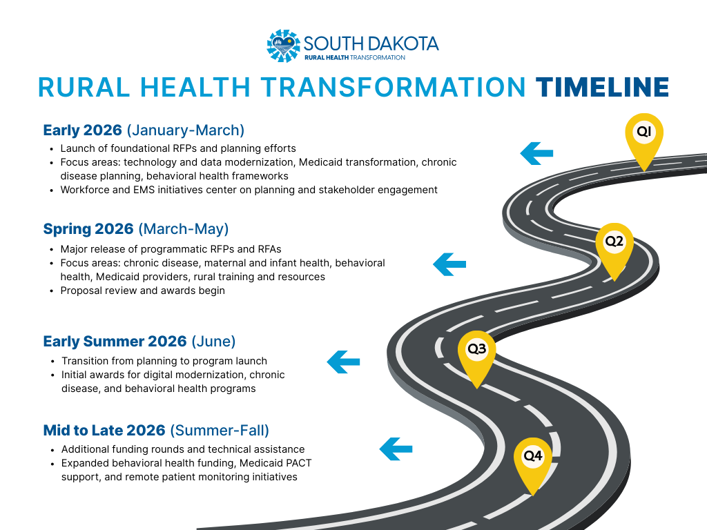
Gov. Rhoden Strengthens Emergency Medical Services Through RHT Grants
Governor Rhoden announced approximately $7.2 million in Rural Health Transformation (RHT) funding for 25 projects aimed at strengthening Emergency Medical Services (EMS) across South Dakota.
Gov. Rhoden Awards Behavioral Health Grants through RHT
Today, Governor Rhoden announced 12 Certified Community Behavioral Health Clinic (CCBHC) modernization and infrastructure grants totaling more than $13 million.
Gov. Rhoden Awards Rural Health Transformation Technology and Data Grants
Governor Rhoden awarded 82 grants to accelerate digital health modernization, strengthen cybersecurity, and enhance interoperability across rural and underserved communities. These grants represent $90 million in technology and data modernization funding statewide from the federal Rural Health Transformation initiative.
Stay in the Know | Email Subscription
Sign up for our email ListServ to get updates on Rural Health Transformation.
Stay Connected
This program is not just about immediate improvements. It is a long-term investment in the health and resilience of South Dakota’s rural communities. As the program moves forward, we will continue sharing updates, resources, and stories from the people and providers making a difference.
Have questions or want to get involved? Submit a Question or Comment Here
This webpage is supported by the Centers for Medicare & Medicaid Services (CMS) of the U.S. Department of Health and Human Services (HHS) as part of the Rural Health Transformation Program, a financial assistance award totaling $189,477,607.26, with 100% funded by CMS/HHS. The contents are those of the SDDOH and SD DSS and do not necessarily represent the official views of, nor an endorsement by, CMS/HHS, or the U.S. Government.